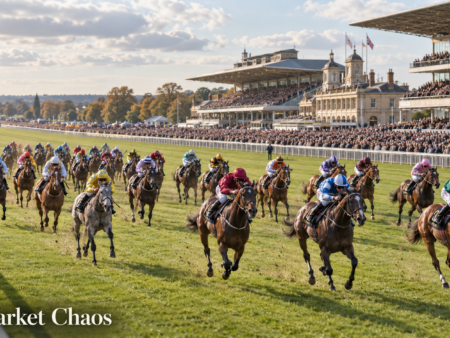
The King George, Lammtarra and the £200 Bet I Never Forgot
There are certain races that tell you more about a horse than any rating ever could.
The King George VI and Queen Elizabeth Stakes is one of them.
Every summer, Ascot brings together the best middle-distance horses from different generations. The leading three-year-olds arrive with their reputations still being formed. The older horses arrive with theirs already established.
That is what gives the race its edge.
A Derby winner can no longer rely on what happened at Epsom. An older champion cannot simply trade on past achievements. Over a mile and a half at Ascot, they have to prove it again.
With this year’s King George now approaching on 25 July, and the race worth a record £2 million, the build-up has already begun. Ascot describes it as the meeting place for Europe’s best middle-distance horses, and that is exactly what the race has always represented.
For me, though, the King George will always bring back one memory above all others.
Lammtarra in 1995.
A serious bet on a serious horse
I had £200 on Lammtarra with Victor Chandler on the rails at Ascot.
That was a very big bet for me at the time.
It was not a casual wager and it was not money I handed over without thinking. I believed Lammtarra was special, but believing that before the race and watching it unfold with £200 riding on the result are two very different things.
Lammtarra had already won the Derby, but the King George was another test entirely.
He was facing older horses and proven Group 1 performers. Carnegie had won the previous year’s Prix de l’Arc de Triomphe. Winged Love had won the Irish Derby. Pentire arrived in top form and was a major threat. This was not a race designed to make Lammtarra look good. It was a proper championship contest.
Frankie Dettori took the ride, replacing Walter Swinburn, who had partnered Lammtarra at Epsom. It would become Frankie’s first King George victory.
When Pentire went past
The race itself was no procession.
Broadway Flyer helped set the pace, while Lammtarra travelled behind the leaders. Pentire was held up before making his move in the straight.
Then came the moment every punter dreads.
Pentire went past Lammtarra.
With two furlongs left, it looked as though the Derby winner might finally be beaten. When you have £200 on a horse, a few seconds can feel like an entire afternoon.
But Lammtarra did not fold.
Under Frankie Dettori, he fought back. The two horses battled all the way to the line, and Lammtarra got there by a neck. The official result records him beating Pentire in a time of 2 minutes 31.01 seconds.
That narrow margin is part of why the race has stayed with me.
An easy victory can show class.
A victory like that shows courage.
Pentire had gone past him and asked the question. Lammtarra found the answer.
That is what champions do.
Four races, four victories
Lammtarra’s entire career lasted only four races.
He won all four.
After winning once as a two-year-old, he returned in 1995 and won the Derby, the King George and the Prix de l’Arc de Triomphe. He then retired unbeaten.
Some will always argue that four starts were not enough to judge him alongside horses who raced over several seasons.
That is a fair argument.
But Lammtarra achieved more in those four appearances than most horses manage in a full career.
He won the Derby after a long absence.
He then beat older horses in the King George.
Finally, he went to Longchamp and won the Arc.
I was fortunate enough to witness that victory as well.
By then, Lammtarra had already shown speed, class and toughness. At Longchamp he completed the treble and closed his career with a perfect record.
No fifth race.
No comeback.
No defeat.
Just four appearances and four wins.
That is why he remains one of the most extraordinary horses I have ever seen.
Years later, another connection
At the time, I thought my connection with Victor Chandler would begin and end with that £200 bet.
Years later, life took me in a completely different direction.
After spending several years in Spain, I eventually ran a property maintenance business in Gibraltar.
My friend Maggie had worked for Victor Chandler for years before going on to establish her own property business, Seekers Property Gibraltar, based at 10 Engineer Lane, just off Main Street.
Through Maggie and the contacts I made around the Rock, my maintenance business began to grow.
Gibraltar is a small place, but property and online gaming are major industries there. If you do a good job and build a reputation, word travels quickly.
One day, that work took me into Victor Chandler’s office.
I was not there to place a bet.
I was there to repair a problem with the lock on his door.
Standing there with my tools, I could not help thinking back to Ascot in 1995.
Years earlier, I had handed over £200 to his firm on the rails and watched Lammtarra fight his way past Pentire.
Now I was in his office fixing his lock.
Life has a strange way of bringing separate moments together.
I never reminded Victor about the bet.
I did not know him particularly well, and I would not pretend otherwise, but in my dealings with him I found him polite, well-mannered and a real gentleman.
He had built one of the best-known names in British bookmaking and later became closely associated with Gibraltar’s rise as a centre for online betting.
Why the King George still matters
The reason this story remains important to me is not simply because Lammtarra won or because the bet came in.
It is because the King George gave me one of those rare racing memories that never fades.
The race had everything.
A Derby winner taking on older horses.
A top-class rival in Pentire.
A famous jockey in Frankie Dettori.
A close finish.
And a horse who refused to be beaten.
That is what the King George is capable of producing.
It does not merely add another Group 1 to a horse’s record.
It can define a career.
That is why the race still matters so much.
The King George asks whether a three-year-old is ready to defeat older horses.
It asks whether an established champion can still hold off the next generation.
It asks which horse deserves to be called the best middle-distance performer of the summer.
And sometimes, as Lammtarra showed in 1995, it gives us a performance that remains vivid more than 30 years later.
As this year’s field prepares to assemble at Ascot, that is the question I will be asking again.
Will we see another very good winner, or will we see a horse produce the kind of performance people are still talking about decades from now?
Because that is the difference with the King George.
It does not just produce winners.
At its best, it produces racing history.