Non-Triers Again, And It’s Always the Little Person Who Pays the Price
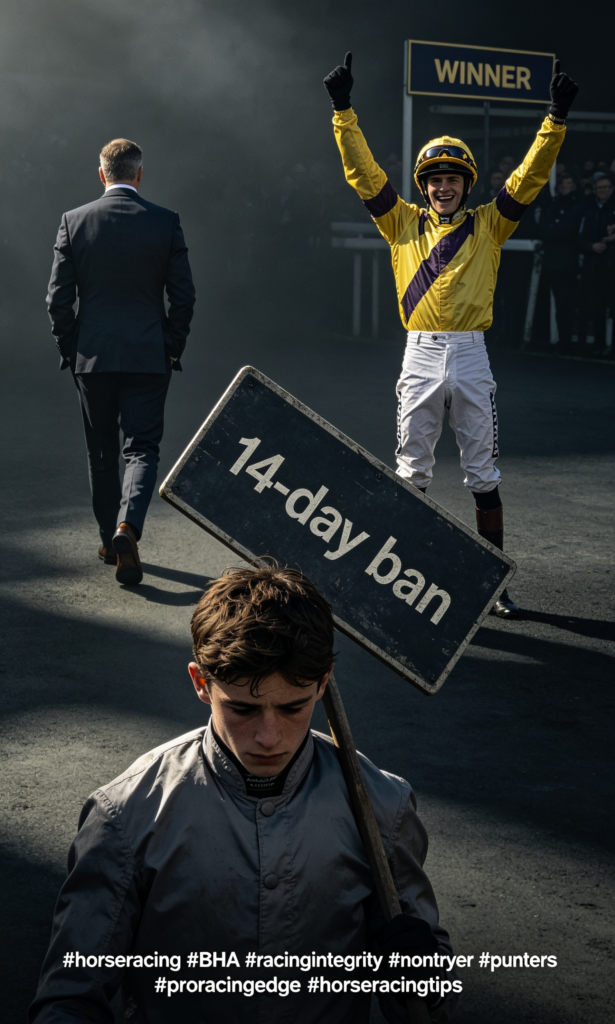
It’s happening again. Another non-trier ruling, another 14-day ban, and another set of punters left wondering what exactly they backed and why the punishment amounts to little more than a long weekend off.
Last Saturday at Ayr, apprentice jockey Amie Waugh was banned for 14 days after stewards ruled she had failed to take all reasonable and permissible measures to ensure Kelpie Grey ran on his merits in a 6 furlong handicap. The Jim Goldie-trained 9-1 chance finished sixth of 14 behind Novamay, beaten four lengths. The Racing Post’s in-running comment told you everything you needed to know, the horse was described as being “tenderly handled” from over a furlong out, never near to challenge.
Tenderly handled. In a competitive handicap. At 9-1. With punters’ money at stake.
The Trainer’s Response
Here’s where it gets interesting. Waugh stated at the inquiry that she had been instructed to drop the horse in, tactics confirmed by trainer Jim Goldie. However Goldie then went on to say that despite following those agreed tactics, Waugh had failed to make sufficient effort and could have been more vigorous.
So the trainer confirmed the riding instructions, then blamed the jockey for how they were executed. Waugh — a 3lb claiming apprentice still learning her trade, carries the ban alone. Goldie walks away without a mark against him.
Make of that what you will.
A Pattern That Won’t Go Away
Regular readers will know this isn’t the first time we’ve covered this topic in recent weeks. Seamie Heffernan received a 14-day ban for a non-trier ruling at Limerick, and was back in the saddle riding a Group 3 winner at Royal Ascot days later. Jack Tudor received 14 days for schooling a horse in a competitive hurdle race at a punter’s expense.
Now Amie Waugh. Another 14 days.
Are we seeing a pattern here? Three non-trier rulings in a matter of weeks, all resulting in identical 14-day bans. All involving punters who backed horses in good faith and received nothing in return. All resolved with punishments that amount to a minor inconvenience for the participants involved.
There is one difference worth noting between this case and the Heffernan one. Heffernan is one of Irish racing’s most celebrated and experienced jockeys. Waugh is a young apprentice claimer with a 3% strike rate this season. The racing forum community has already pointed out the uncomfortable truth, it is always the smaller, less powerful participants who feel the full weight of these rulings, while the bigger names find ways to minimise the impact on their careers and their most prestigious engagements.
Nobody is suggesting the stewards were wrong to ban Waugh. But the question of why the punishments look identical regardless of seniority, profile or the scale of the offence is one the BHA needs to answer.
Let’s be very clear about what a 14-day ban actually means in practice.
Fourteen Days. Again.
For a jockey riding at the lower levels of the sport, 14 days without rides is genuinely painful. For an established name operating at the top of the game, 14 days can be managed around the most important meetings in the calendar. The punishment is not equal in its impact, and a punishment system that hits hardest those with the least power to absorb it is not a deterrent, it is a tax on the weak.
If the BHA is serious about racing integrity they need a sliding scale that reflects the seniority of the participant, the profile of the race, and the financial impact on punters. A flat 14 days for every non-trier ruling regardless of context is not justice. It is box-ticking.
There is something deeply frustrating about watching these cases play out week after week. The punter who backed Kelpie Grey at 9-1 last Saturday did so in the belief that the horse would be ridden on its merits. It wasn’t. Their stake is gone. The inquiry has concluded. The jockey serves two weeks and returns. The trainer continues operating. And the punter who lost their money receives nothing, not even the satisfaction of knowing the punishment fits the offence.
The Punter Always Loses Twice
British racing asks a great deal of the betting public. It asks for trust, for loyalty, for continued investment in a product that is not always easy to love. The least it can do in return is take the integrity of that product seriously enough to make the consequences of undermining it genuinely uncomfortable for those responsible.
Fourteen days is not uncomfortable. It is a footnote.
The BHA needs to do better than this, and the punting public deserves nothing less.